On a long journey yesterday, I finished listening to Amy Hungerford’s Lectures on the American Novel Since 1945, which – by the way – I thoroughly recommend to any one interested in modern literature. Central to her argument is that old patterns in literary novels, such as the ‘Marriage Plot’ of Victorian novels, have more recently been replaced by something she calls ‘the Identity Plot’, in other words, a plot which is primarily about people trying to discover their internalised sense of themselves. Overcoming alienation and difference is the central tension rather than not dying, not being loved or not getting married.
This got me thinking. My friend Jacob tells me that all characters in novels are driven by and can be mapped onto Maslow’s Hierarchy of Needs:
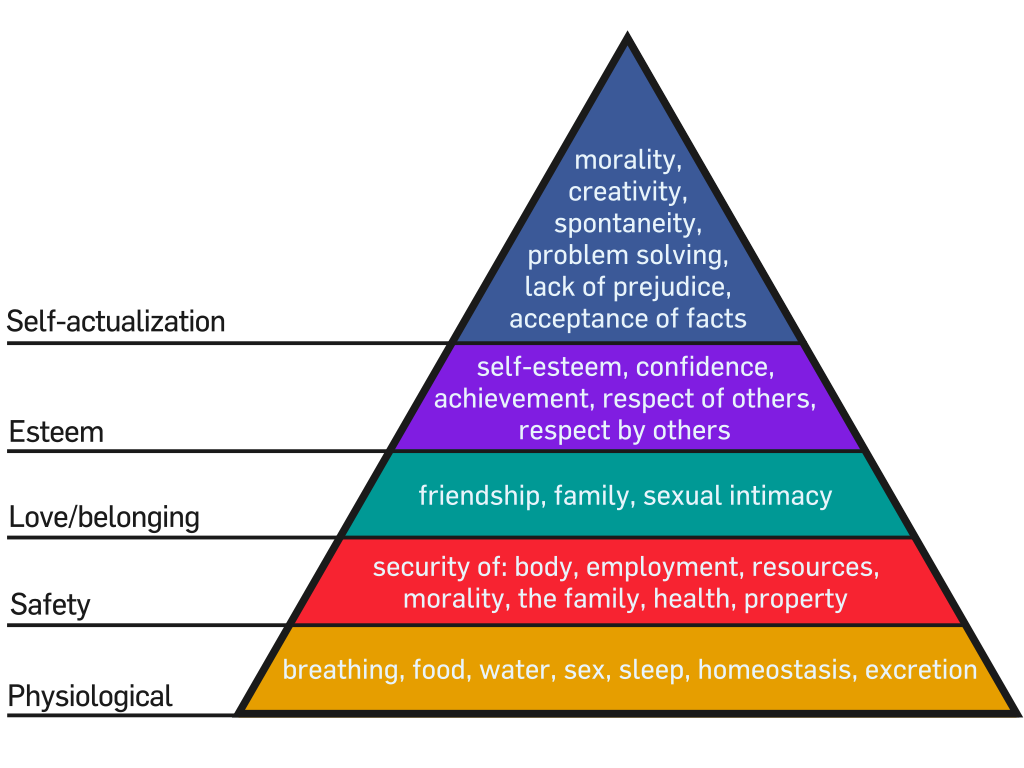
Source: en.wikipedia.org/wiki/Maslow’s_hierarchy_of_needs
So now, I’m thinking, the ‘marriage plot’ is basically about people struggling with the ‘love and belonging’ level, and maybe – just maybe – trying to push themselves towards the self-esteem and position in society that is provided by a ‘good’ Victorian marriage. On the other hand, the ‘Identity Plot’ seems to be another level up. It’s much more about struggling with what the main characters think about themselves than what others think about them. Wow, I can explain this by using Maslow!
From which, I get to the following question: ‘Are all plots about characters struggling with one level or another in this hierarchy?”
- The end of the world, post-apocalyptic novels are way down the bottom: people struggling with survival
- Thrillers and crime novels are one step up: people struggling with safety.
- Marriage plots, rom-coms and Mills & Boon : we’re up with the search for love and family.
- Modernism and the ‘Identity Plot’ has turned inward. There is no longer a physical danger and the idea that a ‘good marriage’ is all you need has been dismissed. Now, you need to ‘self-actualise’ – whatever the hell that means.
OK, I’m not yet sure how that helps me, but I’m going to think about it some more. From now on, one of the questions I’m going to ask about my characters before I commit them to paper is: ‘What’s happening in the hierarchy of needs?’
Discover more from Forged Truth - Fiction is the only truth
Subscribe to get the latest posts sent to your email.

This is so well explained Dave, and fascinating. I shall also ask myself this question in future. Thank you
LikeLike
Not so sure about this Dave
Marriage plots, rom-coms and Mills & Boon : we’re up with the search for love and family.
It seems to fit more with the hierarchy base physiological
LikeLike
The positioning of the search for love and family is Maslow’s, not mine. But to defend his scheme a little bit, he puts sex as a more basic need and family safety on the second tier, so I guess he’s saying sex is a more fundamental instinct than love, as hard wired as breathing and eating, and that we’d kill for our kids, even if we’d let our family relationships fall apart. In terms of the Victorian marriage plot, I don’t think they are about sex; they’re very much about marrying the right person from a love and socio-economic perspective; sometimes tinged with the conflict between the two criteria. It certainly isn’t down on the ‘sex’ level because Victorian novels aren’t about who’s good in bed, though I think you could argue that more modern romantic novels have moved the plot in that direction.
LikeLike
This discussion reminds me of Les Miserables: the heroes struggle to top Maslow’s chart, regardless of their beginnings. Gone With the Wind’s Scarlett O’Hara finally imagines evolving beyond survival on the last page. And you’re right, David, most quests (The Hobbit, for one) seem to skip an individual’s evolution from one level to the next, focusing instead on bend/break survival skills and agendas that affect the strength of the team. Thanks, that’s an intriguing distinction.
Does it imply a thematic dichotomy: quest (team) versus hero (individual)?
I’ve been tilting at this windmill from a different angle for the last few weeks: in a bid to make my culturally distinct villain more authentic, I’ve begun to interrupt my hero’s story with scenes that introduce and develop the villain. I hope they’ll bring dimension to the hero’s challenge and underscore the impossibility of stopping this runaway train.
But if the choice to expose the villain turns my story from a quest into an heroic theme (for lack of better classifications), I wonder what else will or should change. In my updated story, perhaps both hero and villain should take on Maslow’s challenge?
Wow, David, I think I need a coffee. Much appreciated.
LikeLike
Hey Kim/Kevin, Thanks for the feedback. Extending the question you raise a little bit, particularly about scenes introducing and developing the villain: someone recently introduced me to the work of Vladimir Propp on analysing Russian folk tales. I have long tried to look at my plots along the lines of the ‘Hero’s Journey’ (Joseph Campbell etc), but when I read Propp, I realised that the Hero’s Journey is very much an embodiment of the western culture of the individual hero (one man’s battle with Maslow’s hierarchy if you like). The villain gets much more of a point of view (POV) in Russian folk tales, it seems. If you try to line up Propp’s structural analysis against Campbell, it’s a little difficult because Propp breaks it down more finely, but in the end, I think you can see that they are talking about pretty similar plot structures, except that – in Propp – the villain gets to do things while the hero isn’t around, or hasn’t yet arrived on the scene. In Campbell’s analysis using the more western/Greek mythical tradition, the narrative stays firmly in the hero’s POV and anything we (the audience) have missed out on villain-wise is simply filled in by the ‘mentor’ who turns up to give the hero all the necessary back story and challenge him to go out and tackle the villain. (You might think therefore that the western tradition is much more black and white about who’s good and who is bad, but I’m not entirely sure that’s true. I tend to think the Russian folk tale gives the Villain time and space to show just how villainous he is, rather than to try to create a more balanced view of the story’s protagonists.)
Anyway, if you are looking to use structures which are more about ‘team quest’ that individualistic heroes, I recommend you go and take a look at good old Vladimir’s work. It might just help your thinking on presenting your villain.
LikeLike
Hey Kim, my apologies. I got your first name wrong. Looked at the email on the bottom of your post and picked it up wrongly from there. Now I’ve hopped across and had a look at your blog, I’m just embarrassed with myself. Dave (I’ll just go back and do some swift editing)
LikeLike
This discussion reminds me of Les Miserables: the heroes struggle to top Maslow’s chart, regardless of their beginnings. Gone With the Wind’s Scarlett O’Hara finally imagines evolving beyond survival on the last page. And you’re right, David, most quests (The Hobbit, for one) seem to skip an individual’s evolution from one level to the next, focusing instead on bend/break survival skills and agendas that affect the strength of the team. Thanks, that’s an intriguing distinction.
Does it imply a thematic dichotomy: quest (team) versus hero (individual)?
I’ve been tilting at this windmill from a different angle for the last few weeks: in a bid to make my culturally distinct villain more authentic, I’ve begun to interrupt my hero’s story with scenes that introduce and develop the villain. I hope they’ll bring dimension to the hero’s challenge and underscore the impossibility of stopping this runaway train.
But if the choice to expose the villain turns my story from a quest into an heroic theme (for lack of better classifications), I wonder what else will or should change. In my updated story, perhaps both hero and villain should take on Maslow’s challenge?
Wow, David, I think I need a coffee. Much appreciated.
LikeLike
Hi David,
Sorry for the double-post. I didn’t realize my husband’s profile was active. I’m Kim. I reposted, but it’s fine to keep the posts under Kevin’s name, if that’s easier. I hope to return frequently – terrific blog.
Kim Shupenia
kim@jackpotbgl.com
LikeLike
Thank you, David! Looking forward to investigating Vladimir Propp. What an enjoyable Saturday ramble.
LikeLike
Kim, I should perhaps warn you that Propp may know a lot about plot structures, but he has a writing style like wading through cold treacle (and academic cold treacle at that!). However, if you can get through the interminable opening chapters about how he set about his analysis, I think you’ll find the conclusions of his work really interesting. His work is pretty much all laid down in ‘Morphology of The Folk Tale’ or if you just want a summary of the structure he comes up with, you can find a more-or-less bullet point list of his 31 story functions on Wikipedia. Good luck with him! Dave.
LikeLike
S’OK. He’s a Soviet formalist scholar; I didn’t expect Dear Abby 🙂
LikeLike