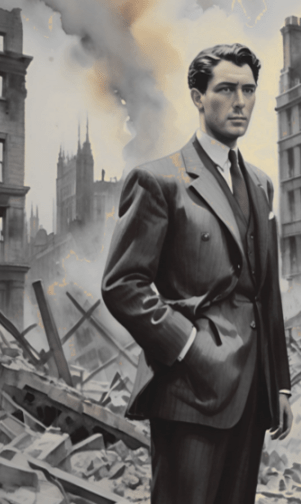
As Forged Truth, we are delighted to bring you the opening chapter of David N. Martin’s ‘The Typewriterists‘ — winner of the 2025 Norman King Award for Fiction.
(Look out for news of his follow up novel ‘The Modern Type’ – to be published by Forged Truth in May 2026.)
Chapter One
Cambrai, December 1917
After the retreat, he was hailed a hero and billeted in a makeshift bedroom that had once been a pigsty in the outbuildings of a grand château. The animal afterscents lingered under those of bleach and carboxylic scrub, but any room with stone walls was better than a tent and any tent better than the insides of a tank along the road to Cambrai. To Eustace Havershall, the lottery of survival felt absurd, but the absurdist thing of all was the typewriter on the three-legged table, its corner propped up by a hay bale.
“What’s that for?” he asked.
“Oh, that,” said the batman assigned to show him the room. “We found it in the wreckage of the main house, Sir. Frog contraption. The Major’s not so taken with ‘newfangled mechanical writing’ — that’s what he calls it — but he says it’ll look more official. On letters to families, you know. I understand there’s a letter to write for one of yours.”
Eustace surveyed the man — the uniform unfeasibly neat, the bowling-ball face well shaved, the cap just so. Out of place. So out of place. Everywhere the world lay in pieces.
“I wouldn’t know how to use it.”
“Orders,” the batman said.
“Damn it! Fancy writing won’t make my gunner less dead.”
“No, Sir. I’d say not. But I wouldn’t be caught saying no when the Major wants it his way. That thing’s been passing from room to room. Some days it moves quick. Everyone hates doing them, see. Everyone hates the letters.”
Eustace perched himself on the edge of the narrow bed, testing the springs with his weight, assessing his new quarters, cold as hell, but this was as much as he could hope for — an oil lamp and a chair, a cracked shaving mirror and a bowl to wash in. His hands looked ugly and scarred against the creamy mattress.
“Who had this room before?”
“A Captain, Sir. Captain Evans. Missing in Action, which means—”
“It means he bought it in the advance, most probably.”
“Yes, Sir. We wouldn’t normally, not with you being a lieutenant, only we heard you was in line for a medal, see. Military Cross, isn’t it?”
“I wouldn’t know.”
“The Quartermaster, he says, ‘Best look after him’, so here we are. We was told you’re the youngest lieutenant the Tank Corps has ever had, the only one who earned it on his own bootstraps?”
“The Tank Corps is four months’ old. There’s not so much history to get past.”
“Yes, Sir.”
Eustace blinked his eyes shut, and when he opened them again, he said, “Have you seen action… ever?”
“Always a Base Rat, Sir. Unfit for Active Duty.”
“Well, let me tell you. I stick my head up through a turret. I shout, ‘Fire’. And then I shout, ‘Fire,’ again. Care to try it? If you can shout loud enough, you could be a lieutenant.”
The batman stared at him in confusion and Eustace felt ashamed of his own anger. He had never considered himself cruel. A killer, yes, by necessity. But not cruel.
“The thing is, a Kraut officer like me is probably writing that letter right now. Same letter. Different uniform. Different boy.”
“Yes, Sir.”
“You have nothing better to say?”
The batman said nothing at all.
Eustace felt his eyes begin to leak. Numb and unexpected, wasn’t that the way of it? He felt nothing, even though beating the odds was everything. There was no grace to it, other than the grace of better luck.
Several minutes passed him by. The batman was nowhere to be seen, but in that time, Eustace Havershall had hardened the armour needed for living. He would be alright.
That morning, twenty-five Mark IV tanks had limped back here to safety, his own among them. More than four hundred had started the advance. He had seen most of them broken or burned out between here and Cambrai. Now the chill of evening was biting hard and there wasn’t even the roughest alcohol to be had.
He lit the oil lamp and sat at the table with a bartered cigarette on his lip. Its smoke danced above the lamp shade as he tried to fathom how paper was supposed to roll around the typewriter’s platen. Mechanical writing or not, the letter had to be written.
The label on the machine said 1895, the year of Eustace’s birth. It looked and felt solid — a polished wooden casing, a galvanised steel chassis, ivory keys on metal levers, their associated typebars resting in a semi-circular cut-out above the keyboard. He had to press a key down almost two inches to swing a typeface up to hit the page. Key strokes came with a mechanical thwack.
‘dear mrsmast…’
Dammit! Scrap that sheet. Try again.
‘dear mrs masterson,we regr et …’
Three attempts failed before he realised he had to hold down a special key to make capital letters. Typing ‘Your son did his duty’ revealed a problem with the ‘H’ and ‘Y’ keys. The typefaces stuck against the platen and refused to return until Eustace poked them with his finger. His hands were shaking against the cold. The truth was a larger problem. Mechanical words could not capture the shape of loss.
He was staring at another hopeless attempt when the Sergeant coughed to announce his arrival. There was no door to mark the entrance, only a tattered curtain that hung lopsidedly.
“Permission to disturb you?”
Sergeant Joseph Woodmansey was a northern lad, runtishly slight, acne from cheek to cheek, lost half a big toe a month previous. But a whiz with machinery, always talking about cars and motor cycles, smelt of pickles even when pickles had not been in the ration for weeks. Out in the field, he was the saviour of their tank.
“The men sent me to ask. We’ve all got passes out tonight and—”
“And what, Woody? You can talk freely here.”
“I know it ‘ent regular, but none of it’s regular.”
“You’re off to the village? Well deserved.”
“Madame Franny’s. We thought you might like to… to remember Masterson, you know? It ‘ent regular, officers and other ranks together, but the thing is, you ‘ent a toff like the others.”
Eustace smiled. “I think of myself as a temporary gentleman. I don’t presume to have the breeding to make it stick.”
“Well, Sir, we know what you done. We’d all have done it. In your place, that is, and it’s just between us, that’s what we decided. This place in the village, the maison tolérée, it’s a bloomin’ good one, I’m told. They have musicians and we want to give him a send off. A wake, you know? Him being Irish.”
Eustace gestured to the page on which he’d got as far as ‘Dear Mrs Masterson…’ before the ‘Y’ of ‘Your’ had stuck again.
“Know anything about these things, Woody? You’re the engineer. I’m told it’s use is a Brass Hat order.” He released the ‘Y’ and then pressed its key — same thwack, same jammed result. “It seems you can fix anything.”
“Not really. I had a piece of good fortune fixing the tank, that’s all.”
“Nonsense. We were stranded otherwise. If you stop, you’re dead, isn’t that what they say?” He waited a while, then added, “It seems the Brass is putting me up for a medal, maybe a promotion. Captain Havershall, how would that sound?”
It sounded to Eustace like dead man’s shoes. He laughed to drown the thoughts that came echoing in its wake.
Woody shook his head, expressing no opinion. He lent over the typewriter’s mechanism. “I reckon Heath Robinson would be proud. Happen I know about things that move and shoot. War things. If it doesn’t blow up or kill you, it’s useless out here. Same goes for the soldiers.”
Useful things you win medals for…
Ten days earlier, within the ungodly confines of a Mark IV tank, Eustace had led seven crew across the soft-walled ditches on the way to Cambrai. Fascines of brushwood gathered for the purpose bore them across trenches and ditches. On the flat, they swept aside the barbed fences. Advancing miles over the line in a morning, the supporting foot soldiers and cavalry slipped back out of sight. The army command had not planned for such success — one bold tank that made it further than the rest.
Eustace stood up through the hatch in the front turret, tin-hatted in the gunpowdered air, metal mesh above his head to deflect grenades. He gulped for oxygen. Briefly free. He surveyed the mud fields of smoke. Below, men awaited his command. Blenkinsop, Jones, Masterson, Mulgrove, Priestley, McAllister and Woodmansey — all his responsibility.
Without warning, their tank was hit low on the starboard side near the sponson. His head jerked sideways. Vision blurred. It felt like falling. He couldn’t breathe for the sudden showers of dirt. His ears were ringing.
It took seconds to realise the tank had tipped up on one side then crashed back to the ground. The mechanical rumble supporting him clanked itself into silence.
“Fuck. Fuck. Oh, God, fuck,” he heard from below. Someone screamed.
Stay calm. Maintain command. An officer had tricks to avoid the experience of fear. Two flies landed on the exposed back of the turret lid. Eustace watched the gently flexing wings and rubbing legs, took another few seconds to refind rhythm in his breathing.
“Is there a problem, Lads?” Quite matter-of-fact as he ducked into the tank’s innards. The confinement down there terrified him. He always had to hide it.
Masterson, the gunner, had slumped from his position in the starboard sponson. He’d fallen back into the narrow gap between his big six-pounder and the tank’s engine bay. Everyone had rushed to get a look. He was twitching when they got a torch on him.
Eustace saw it all — the flesh torn off the cheek, smashed bone visible, caught by the shell splatter, oozing blood. Moments before Herbert Masterson looked young and perfect, as the world had done before the war.
More failures with the letter brought Eustace to a frustrated intermission. He stopped and looked at himself in the mirror. Like all the men — officer or not — he had descended to hair lice and grubby fingernails. His fingers held tracks like black veins, filled with trench dirt and powder burns that couldn’t be scrubbed out by the mobile bath units that occasionally rolled in on the back of lorries. The best moments of his days were the first brief seconds of the morning before he remembered his sins.
Eustace’s forefathers were devoutly religious lace makers, the factory masters of Victorian Nottinghamshire. Although profits in the cloth trade declined with the new century, the Havershall boys — a trio of brothers — were sent to third-tier public schools, raised on sermons from the pulpit, the restless cane of gin-soaked headmasters and the rationed attention of parents.
As middle son, Eustace always knew he was the least favoured, neither heir to his father’s remaining fortune nor his mother’s darling. He tried to fit in. When the stiffened resolve of recruiting officers helped school friends sign up, he bit on the lie — the Church first, King and Country close after. He signed for the short campaign they were promised. He thought his father would approve, might perhaps be proud, even if his mother worried. The stoic Christian faith of the family remained.
Belatedly, examining the man he had become in that mirror, he decided he would take Woody’s invitation. He reached in his pack for a cleaner shirt, pulled on his boots and set off into the evening with his men, his letter unwritten on the typewriter’s platen.
So the survivors of Cambrai introduced themselves to the whores of Madame Franny’s. As a group, his tank crew sat and talked, drinking in the salon. Eustace listened, learning their truths as he hid his own.
They seemed to get louder and his thoughts grew more troubling. Soldiers still, they might never reach home, because there was another war tomorrow. Every day, another and another, and the only ones who escaped were dead, or shipped away in pieces or both.
A sweet copper-haired girl — she smelt of rosewater and called herself Maisie — slipped her hand inside his. He sat sipping vinegary red wine from a grubby glass. A one-eyed pianist played popular English tunes on a nearby upright while the singer took a break. Maisie’s soft fingers worked their promises against Eustace’s palm.
“When I’m free of this…” Woody piped up. He was sandwiched between two working girls on a stained velvet sofa. Small he might be, but the lad consumed vast quantities of alcohol without apparent effect.
“If you are, if we’re ever bloody free,” said Priestley, their port side gunner.
Mulgrove, the tank’s driver, the most obviously drunk, said, “We’re none of us free. We’re not fighting for ourselves. We’re fighting for them.”
‘Them’ was not defined. ‘Them’ was an assumed and hated ‘them’, a privileged ‘them’. Eustace’s companions shook their heads in dull agreement.
After a while, Mulgrove ran out of words and began to paw at one of the girls, pulling aside her shapeless blouse. She smiled professionally.
Woody said, “I’ve been wondering about your machine, Lieutenant. Not the tank, the writing machine.”
“I thought you’d condemned it useless.”
“Aye, it is, out here, Sir. But afterwards, when we get home… if we get home.”
“If…” Priestley repeated. “If…”
Priestley was older than the rest, mid-thirties. He had fought the Boers in South Africa. His uncertainty sent them all into silence.
Eustace could see now. He had been but half-weaned into the world when war plucked him from his parents’ house, and in France, he had become that half-and-half creature that belonged no where. Not Mulgrove’s ‘them’, but certainly not ’us’ either.
He remembered the leather-bound library his grandfather had assembled and abandoned in that Nottinghamshire house, folios of Shakespeare and Milton that no one but Eustace attempted to read. And, oh yes, the tired soap-box seditions of his mother’s drawing room where rich folk played the bleeding heart. Lunch with the vicar; tea with the revolutionaries. The family talked and talked, paying liberal service to women’s rights and Irish home rule, pretending to demand progress. The change his parents craved was a little advancement, a recovery of due privilege, maybe a royal honour for his worthy father, while all the time, the industry that had supported his ancestors edged into decline.
On Eustace’s first trip to London, his father had argued with policemen about the inconvenience of a suffragette rally crossing their path. The parlour talk, it seemed, did not extend beyond the family’s front door. Certainly not as far as Piccadilly Circus. Or to women chained to railings.
That was 1913. He was seventeen. He had already begun to hate his father.
A society girl in summer dress and yellow bonnet was distributing ‘Votes for Women’ leaflets. She dropped her pile.
His father tapped him on the shoulder, pointed her out, laughed at her dilemma. Eustace rushed forward to help her. She smiled at him as he picked up the leaflets, her painted eyebrows arching into brackets. He wanted to introduce himself, shake her hand perhaps, but a girl like that would think it forward. She never offered.
His father told him, “You’re knocking on the wrong door, Son. Don’t you always?”
Here’s the truth his father would deny: the girl was old money and of a class Havershalls would never reach. Lace mills and Christian industry had failed to make gentry of the manufacturing classes in Victorian England. Havershall money had looked too new while they had it, and now it was dwindling away before it had a chance to be old.
Eustace carried away the idea of her — her wealth, her poise — and he liked the way she annoyed his father. She was the real ‘them’, a toff his father would have said, seductive and wrong and out of reach. Eustace had wanted that, if only for a moment, or maybe several moments, or maybe he still did. Did it matter out here in this hell? Here, they were all dying one at a time. Here only tomorrow mattered. The men had invited him to this wake. He belonged with them. Almost. But not quite.
When Eustace snapped out of his daydream, it was still Maisie with her fingers against the scars in his palm. He noticed now how young she looked. Too young for this, but then everyone is too young for war.
It wasn’t that he hadn’t ‘indulged’ before. As a new recruit, it had been a rite of passage, thirty feral seconds to plant a flag. It might be all you got. He had racked up a minute and a half in three years. Stealing more time seemed wrong now. After Cambrai.
Maisie’s copper hair brushed Eustace’s cheek. She started to whisper in his ear.
“Tu es troublé? You wish to forget?”
She promised a menu of delights in the upstairs rooms, things that might remove his troubles. A stirring of desire, yes, but his troubles and desires were tangled up in yellow bonnets and money, and all the things that might set himself apart from his father and everything else.
In the background, Mulgrove was shouting, “D’you think she’s been handed to you for your pleasure? No, boys. Who gets your daily sixpence, while you’re busy getting syph spots on your knob? These places are run by the Frog government. They give. And take back. And we fight for them. We die for them.”
There were moments inside the stricken tank that Eustace constantly relived — the smell of fear and lost dignities and hot greasy metal reshaping everything; the air thickening. Would the Germans get to them before the British advance caught them up? Masterson moaned, dying slowly.
Priestley and Blenkinsop were kneeling over the boy, trying to raise his head. Priestley grasped him by the hand. Masterson mumbled, “Please, please…”
“Help the poor bugger, Lieutenant… someone… for God’s sake, help him.”
“Please, please…”
All eyes fell on Eustace. He had no answer. Woody leaned in at his ear.
“It wasn’t the blast, Sir. It was when we tipped. It must have knocked something loose. In the gubbins underneath, I reckon.”
Masterson had taken Eustace’s attention. He’d forgotten for a moment that the engine had stopped. Masterson was lost, but all eight of them were doomed.
Woody said, “I can fix it, Sir, maybe… if I go outside… crawl underneath, like.”
“You can’t go outside, Woody. I wouldn’t send–”
“No, not an order, Sir. I’m a volunteer. If we do nothing… well, we’re all like Masterson.”
Seconds passed. Outside, the guns boomed. Eustace had never sent anyone to die, not even a volunteer.
“Alright,” he said. “You go. I’ll deal with this.”
He looked down at Masterson and then at his own hands. His beaded sweat seemed to want no part of the pitted skin, no part of what must be done. He unfurled fingers one at a time, rubbed together the slickness between their tips, then unclipped his Webley revolver from its holster.
And the rest? What happened afterwards?
Well, he remembered Woody’s return, that moment when Sergeant Woodmansey ducked back inside through the manhole in the middle turret.
“Try it now,” he said with surprising confidence.
And the engine started. On the third turn of the starting handle.
Ecstasy came out of despair. Unexpected and undeserved. The survivors whooped for joy like Lazarus. The roar and rattle remade everything.
Nearly everything. Everything but Masterson.
THE TYPEWRITERISTS is available now on Amazon
